
Outline
The schema enzymes contains tables for recorded enzymatic activity using the Soil Enzyme Activity Reader (SEAR) developed by Digit-Soil AG. Each read records the activity of 5 different enzymes, with 5 replicas of each enzyme.
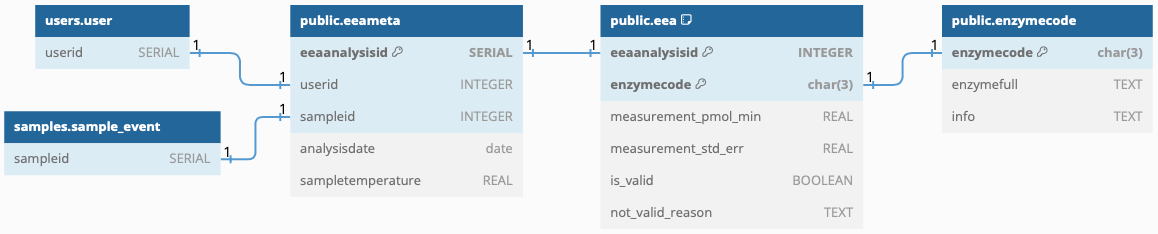
The schema enzymes is built along the same principles as the other schemas for laboratory derived soil properties, wetlab and edna. The sampleid and userid are derived from other schemas and registered together with other metadata for each SEAR analysis in the table eeameta. Each SEAR analysis is given a uique (SERIAL) id, that is then used for linking to the results (table: eea [extracellular enzymatic activity]).
The actual SEAR results are thus stored in the table eea, with each individual enzyme in a separate record. The enzyme is registered using a 3 letter code, expanded in the support table enzymecode.
DBML
/// Use DBML to define your database structure
// Docs: https://dbml.dbdiagram.io/docs
// Tool: https://dbdiagram.io/d

Project project_name {
  database_type: 'PostgreSQL'
  Note: 'AI4SH schema for enzyme data'
}

Table users.user {
  userid SERIAL
}

Table samples.sample_event {
  sampleid SERIAL
}

Table eeameta {
  eeaanalysisid SERIAL [pk]
  userid INTEGER
  sampleid INTEGER
  analysisdate date
  sampletemperature REAL
}

Table enzymecode {
  enzymecode char(3) [pk]
  enzymefull TEXT
  info TEXT
}
// enzymecodes
//  GLA: Chitinase/ β-glucosaminidase,
//  GLU: β-Glucosidase,
//  PHO: phosphatases (Phosphomonesterases),
//  XYL: β-Xylosidase,
//  LEU: Leucine- aminopeptidase.

Table eea {
  eeaanalysisid INTEGER [pk]
  enzymecode char(3) [pk]
  measurement_pmol_min REAL
  measurement_std_err REAL
  is_valid BOOLEAN
  not_valid_reason TEXT
}

Ref: "samples"."sample_event"."sampleid" - "public"."eeameta"."sampleid"

Ref: "public"."eeameta"."eeaanalysisid" - "public"."eea"."eeaanalysisid"

Ref: "public"."enzymecode"."enzymecode" - "public"."eea"."enzymecode"

Ref: "users"."user"."userid" - "public"."eeameta"."userid"
Figure