Outline
Macrofauna observations will neither be taken at all pilots, nor at all sites/points at the pilots where it will actually be included. Whether or not to do a macrofauna analysis at a particular sample point is defined in the sites schema (table: sites.point_insitu_methods).
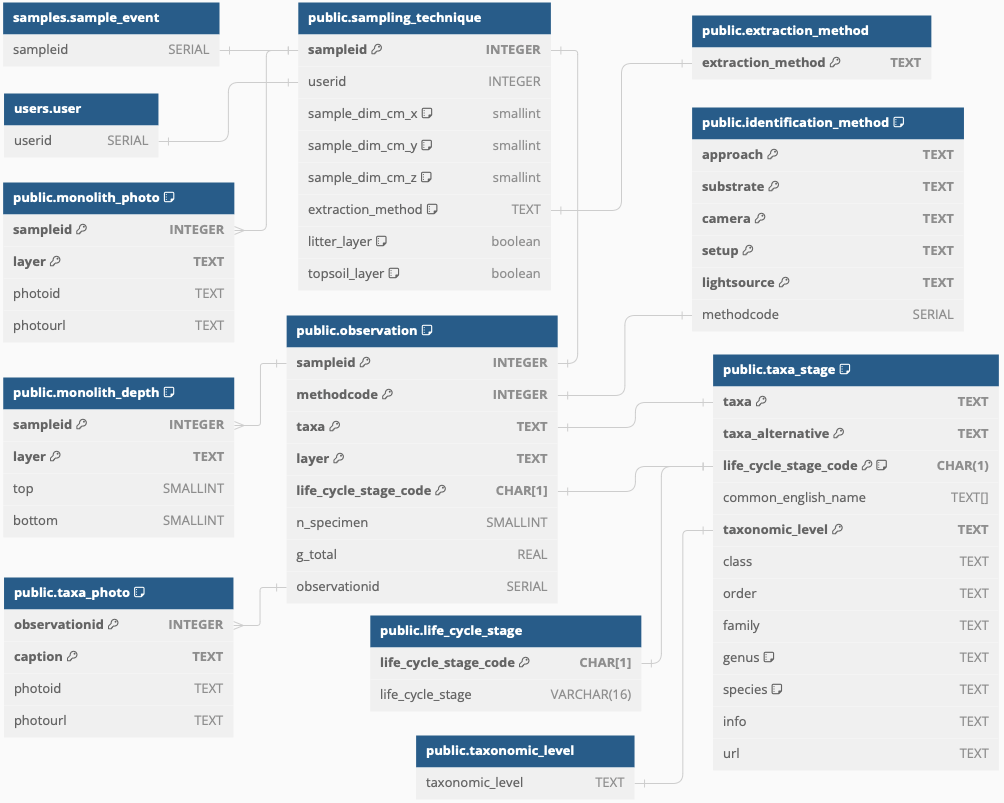
The default method for macrofauna analysis is to excavate a soil monolith of 25 * 25 cm and hand sort the macrofauna separately from two different layers:
- litter (on top of the actual soil profile),
- top soil (0-20 cm).
The alternative is to pour either mustard oil of mustard water over the soil surface, usually also 25 * 25 cm, and just capture and observe the earthworms that crawl up. The registration of the excavation method is done in the schema samples and then linked via the sampleid.
Each sample point where a macrofauna analysis is performed can be be linked to a special photo showing the detailed ground conditons - preferable with a frame laid out to indicate the exact area (i.e. the 25 * 25 cm square). Such monolith photos are registered in the table monolith_photo. Monolith photos can be registered for each layer.
In addition to the excavation method, the observation of macrofauana also requires a tool/method for extracting the creatures from the soil, i.e. an extraction_method. Applying mustard to the soil surface accomplishes excavation and extraction in one single process. But for the default method of excavation a soil monolith a second step of extraction is required. Default is to use hand-sorting, but alternatively applying heat can also be used. The exact method to apply for any sample must be pre-registered in the catalog extraction_method, and selected using a drop-down list.
The table for recording macrofauna (observation) contains columns for layer, taxa, life_cycle_stage_code, n_specimen (number of specimens) and g_total (total biomass of taxa in grams), and the sampleid (linking to the sample event and further up the chain to the sample point, site and pilot). Each new record in the table observation is given a new (SERIAL) id, observationid. Photographs of the taxa represented in an observation can then be linked using the observationid and registered in the table taxa_photo. Any number of photos can be linked to the same observationid as long as caption field differs.
The identification of taxa is by default manual, but semi-automated or fully automated methods using 2D or 3D images is tested as part of AI4SH. Thus each taxa result (table: observation) must be accompanied with the identification method applied. As the image based identification is under development, the support table for defining the identification method, identification_method, includes columns for defining both the camera and light setup and the substrate used as background.
The landscape (above ground) characteristics and the cultivation methods and its history are covered in the landscape, landstate and weather schemas. The analyser of the macrofauna must be registered separately, by linking to the users schema.
Idea and objective
The schema macrofauna is one of several sibling schemas for registering in-situ data analysis results. For all of these siblings, information on the sample point (pilot, site), are linked via the schema sites. Information on the sampling event is linked via the samples schema.
To insert a macrofauna observation into the observation tables, the taxa to insert must be registered in the taxa_stage table. All insertions should use the latin name (regardless of the taxonomic level) and no manual entry should be allowed. The only way to enter a taxa should be via a drop down menu listing all allowed entries. To support the field observer the table storing all the allowed taxa could also have vernacular names. But only to support searching for the observation - once entered into the database it should automatically be the latin name regardless of how the observer identified the taxa.
The initial default taxa to use are listed separately below. New taxa should only be allowed for expert users to add.
To allow the comparison of manual, semi-automated and fully automated macrofauna identification methods, the table identification_methods is used for defining the precise identification method. Each recorded taxa from the two default layers (litter and topsoil) are registered in the table observation and must be linked to an identification method. This allows cross-comparison of different image based setups, both against each other and vis-a-vis the manual identification, at a taxa level.
Macrofauna wiki page
DBML
// Use DBML to define your database structure
// Docs: https://dbml.dbdiagram.io/docs
// Tool: https://dbdiagram.io/d

Project project_name {
  database_type: 'PostgreSQL'
  Note: 'AI4SH schema for macrofauna measurements'
}

Table users.user {
  userid SERIAL
}

Table samples.sample_event {
  sampleid SERIAL
}

Table sampling_technique {
  sampleid INTEGER [pk]
  userid INTEGER
  sample_dim_cm_x smallint [default: 25]
  sample_dim_cm_y smallint [default: 25]
  sample_dim_cm_z smallint [default: 20]
  extraction_method TEXT [default: "hand_sorting"]
  litter_layer boolean [default: True]
  topsoil_layer boolean [default: True]
}

Table extraction_method {
  extraction_method TEXT [pk]
}
// extraction_method alternatives: "hand_sorting", "mustard_oil", "mustard_powder"

Table identification_method {
  approach TEXT [pk]
  substrate TEXT [pk]
  camera TEXT [pk]
  setup TEXT [pk]
  lightsource TEXT [pk]
  methodcode SERIAL
}
// approach alternatives: "manual", "image"
// substrate alterantives: "NA", "whitepaper", "whitecloth", "mirror", "glass", "shoebox"
// camera alternatives: "NA", "singlemobile", "dualmobile", "singlesystemcamera", "dualsystemcamera", "3Dscan"
// setup alternatives: "NA", "handheld", "singletripod", "dualtripod", "3Dscan"
// lightsource alternatives: "NA", "outdoo", 'indoor', "flash", "singlelamp", "duallamp", "3Dscan"

Table observation {
  sampleid INTEGER [pk]
  methodcode INTEGER [pk]
  taxa TEXT [pk]
  layer TEXT [pk]
  life_cycle_stage_code CHAR[1] [pk]
  n_specimen SMALLINT
  g_total REAL
  observationid SERIAL
}

Table monolith_photo {
 sampleid INTEGER [pk]
 layer TEXT [pk]
 photoid TEXT
 photourl TEXT
}

Table monolith_depth {
 sampleid INTEGER [pk]
 layer TEXT [pk]
 top SMALLINT
 bottom SMALLINT
}

Table taxa_photo {
 observationid INTEGER [pk]
 caption TEXT [pk]
 photoid TEXT
 photourl TEXT
}

Table life_cycle_stage {
  life_cycle_stage_code CHAR[1] [pk]
  life_cycle_stage VARCHAR(16)
}
// life_cycle_stage alternatives:  A=adult, C=cocoon, L = Larvae, J=juvenile, N= Nymph, E= Egg, P=Pupa,

Table taxa_stage {
  taxa TEXT [pk]
  taxa_alternative TEXT [pk]
  life_cycle_stage_code CHAR(1) [default: 'A', pk]
  common_english_name TEXT[]
  taxonomic_level TEXT [pk]
  class TEXT
  order TEXT
  family TEXT
  genus TEXT [default: 'NA']
  species TEXT [default: 'NA']
  info TEXT
  url TEXT
}

Table taxonomic_level {
  taxonomic_level TEXT
}
// taxonomic_levels alternatives:  Species, Genus, Family, Order, Class, Phylum, Kingdom, Domain

REF: samples.sample_event.sampleid - sampling_technique.sampleid

REF: users.user.userid - sampling_technique.userid

REF: sampling_technique.sampleid - observation.sampleid

Ref: sampling_technique.extraction_method - extraction_method.extraction_method

Ref: identification_method.methodcode - observation.methodcode

Ref: "public"."observation"."taxa" - "public"."taxa_stage"."taxa"

Ref: "public"."observation"."life_cycle_stage_code" - "public"."taxa_stage"."life_cycle_stage_code"

Ref: "public"."taxa_stage"."life_cycle_stage_code" - "public"."life_cycle_stage"."life_cycle_stage_code"

Ref: "public"."taxa_stage"."taxonomic_level" - "public"."taxonomic_level"."taxonomic_level"


Ref: "public"."sampling_technique"."sampleid" < "public"."monolith_photo"."sampleid"


Ref: "public"."observation"."observationid" < "public"."taxa_photo"."observationid"

Ref: "public"."observation"."sampleid" < "public"."monolith_depth"."sampleid"
Initial taxa to use for the macrofauna registration, their taxonomic levels and common English names. Note that some entries are overlapping in such way that a lower hierarchical level (e.g. family) is a breakout from a higher level (e.g order).
// taxa: Dermaptera
// alternative_taxa: acari
// code: -
// taxa_system_level: order
// common_english_name: ['earwigs']
// phylum: Arthropoda
// class: insecta
// order: Dermaptera
// family: NA

// taxa: Acarina
// alternative_taxa: acari
// code: AR
// taxa_system_level: order
// common_english_name: ['mites','ticks']
// class: arachnida
// order: acarina

// taxa Araneidae
// alternative_taxa: NA
// code: -
// taxa_system_level: family
// common_english_name: ['orb-weaver spiders']
// class: arachnida
// order: araneidae
// family: araneidae

// taxa: blattaria
// alternative_taxa: blattodea
// code: BL
// taxa_system_level: order
// common_english_name: ['cockroach']
// phylum: Arthropoda
// class: insecta
// order: Blattaria
// family: NA

// taxa chilopoda
// alternative_taxa: NA
// code: CH
// taxa_system_level: class
// common_english_name: ['centipedes']
// class: chilopoda
// order: NA
// family: NA

// taxa: Coleoptera
// alternative_taxa: NA
// code: CO
// taxa_system_level: order
// common_english_name: ['beetle']
// phylum: Arthropoda
// class: insecta
// order: Coleoptera
// family: NA

// taxa: Collembola
// alternative_taxa: NA
// taxa_system_level: class
// common_english_name: ['springtales']
// phylum: Arthropoda
// class: collembola
// order: NA
// family: NA

// taxa: Dictyoptera
// alternative_taxa: NA
// taxa_system_level: genus
// common_english_name: ['net-winged beetles']
// phylum: Arthropoda
// class: insecta
// order: Coleoptera
// family: Lycidae
// Genus: Dictyoptera

// taxa: Diplopoda
// code: DI
// alternative_taxa: NA
// taxa_system_level: class
// common_english_name: ['millipede']
// phylum: Arthropoda
// class: Diplopoda
// order: NA
// family: NA
// Genus: NA

// taxa: Diploura
// alternative_taxa: Diplura
// taxa_system_level: order
// common_english_name: ['two-pronged bristletails']
// phylum: Arthropoda
// class: Diplura
// order: NA
// family: NA
// Genus: NA

// taxa: Diptera
// alternative_taxa: NA
// code: DI
// taxa_system_level: order
// common_english_name: ['fly']
// phylum: Arthropoda
// class: insecta
// order: Diptera
// family: NA
// Genus: NA

// taxa: Gasteropoda
// alternative_taxa: Gastropoda
// code: GA
// taxa_system_level: class
// common_english_name: ['slugs', 'snails']
// phylum: Mollusca
// class: Gasteropoda
// order: NA
// family: NA
// Genus: NA

// taxa Hemiptera
// alternative_taxa: NA
// code: HM
// taxa_system_level: order
// common_english_name ['true bugs']
// phylum: Arthropoda
// class: insecta
// order: Hemiptera
// family: NA
// Genus: NA

// taxa Hymenoptera
// alternative_taxa: NA
// code: -
// taxa_system_level: order
// common_english_name ['sawfiles','wasps','bees','ants']
// phylum: Arthropoda
// class: insecta
// order: Hymenoptera
// family: NA
// Genus: NA

// taxa Formicidae
// alternative_taxa: NA
// code: AN
// taxa_system_level: order
// common_english_name ['ants']
// phylum: Arthropoda
// class: insecta
// order: Hymenoptera
// family: Formicidae
// Genus: NA

// taxa Lepidoptera
// alternative_taxa: NA
// code: LE
// taxa_system_level: order
// common_english_name ['butterflies']
// phylum: Arthropoda
// class: insecta
// order: Lepidoptera
// family: NA
// Genus: NA

// taxa: Termite
// alternative_taxa: NA
// code: TE
// taxa_system_level: family
// common_english_name: ['termite']
// phylum: Arthropoda
// class: insecta
// order: Blattodea
// family: Termite
// Genus: NA
Figure